

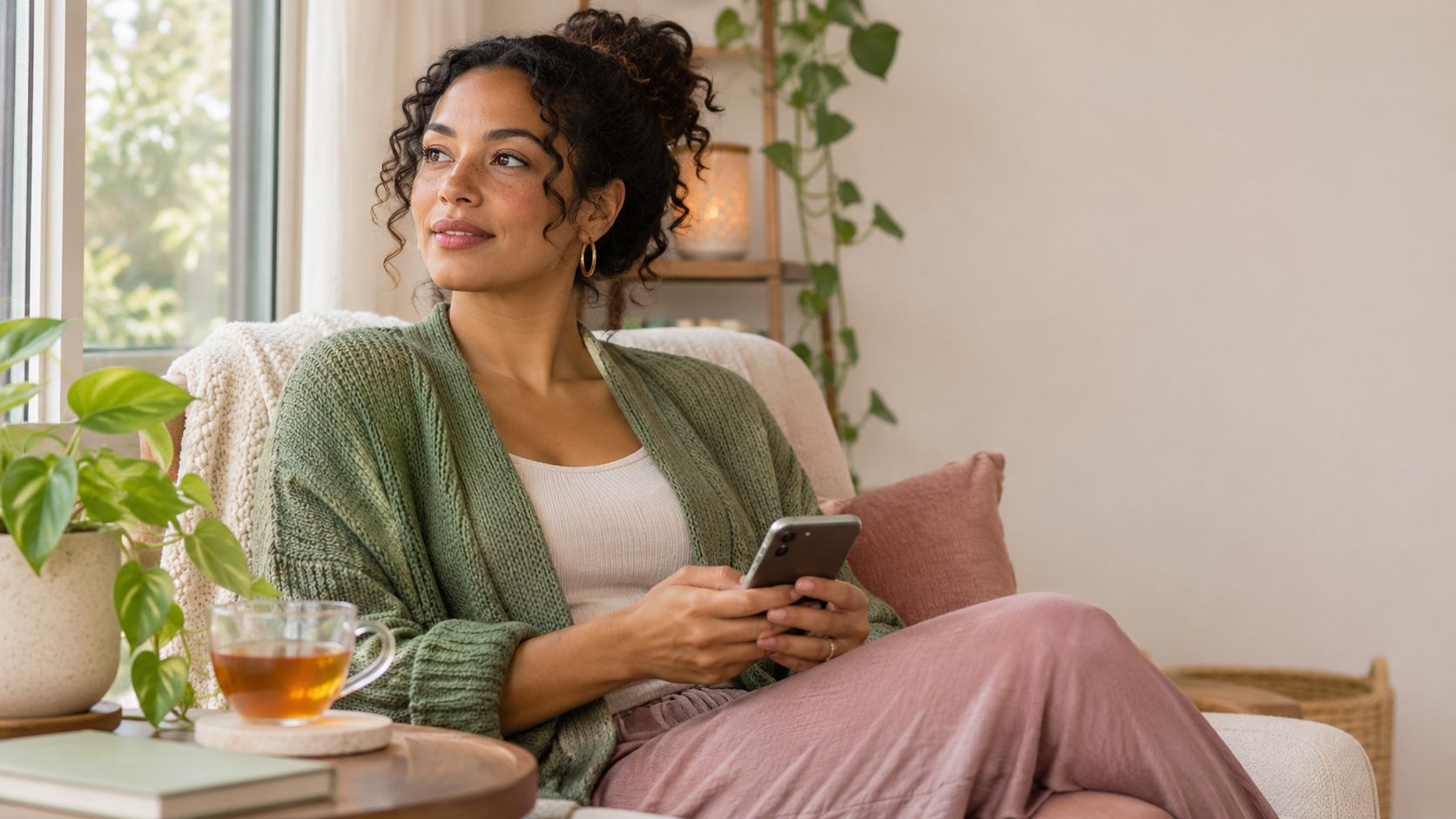
Social media can help women feel connected, informed, and understood. It can also contribute to comparison, disrupted sleep, body-image concerns, and emotional strain. The effect depends on what you see, how you use it, what is happening in your life, and how you feel during and after using it.
If you have ever opened an app for a quick break and left feeling inadequate, anxious, or exhausted, you are not alone. You do not need to decide that social media is entirely good or entirely bad. Understanding which experiences affect you can help you make changes that protect your wellbeing while keeping the connections and information you value.
The short answer: How social media can affect mental health
Social media can influence women’s mental health through the content they see, the people they interact with, and the time and attention online activity takes from other parts of life. Supportive communities may reduce isolation, while appearance pressure, harassment, distressing content, or lost sleep can contribute to distress.
These effects are not the same for everyone. Social media is one part of a much larger picture that can include relationships, physical health, work, finances, discrimination, and previous mental health experiences.
What does the research say?
Research suggests that social media’s relationship with mental health is complex. Some studies ask whether people who use social media differently also report different symptoms. Others test what happens when people are exposed to particular content.
Both can be useful, but they answer different questions.
Some experiments show short-term effects on body satisfaction
A 2025 analysis combined 20 experimental studies involving 3,603 young female participants. On average, exposure to idealized body content reduced body satisfaction, while exposure to body-positive content improved it compared with control conditions.
This provides evidence that certain types of content can affect body satisfaction in the short term. It does not mean every woman will respond the same way, or that seeing such content will cause a mental health disorder. The studies focused on young female participants, so their results should not automatically be generalized to women of every age and background.
Anxiety and depression involve more than one cause
Research has found associations between some patterns of social media use and mental health concerns. But an association alone does not establish what caused what.
For example, someone who feels lonely might spend more time online seeking connection. Some experiences online could also make loneliness worse. Both may be happening, along with other influences.
A large review of research on online social comparison found that more comparison was associated with greater body-image concerns and eating-disorder symptoms. That finding identifies a meaningful relationship; it does not prove that comparing online caused an eating disorder in any individual.
A useful takeaway: Pay attention to the content, interactions, and habits that affect you, rather than assuming that every minute online has the same effect.
Common ways social media can affect women
1. Body image and self-esteem
Body image refers to how you think and feel about your body and how those thoughts affect your behavior.
Social media can expose you to repeated appearance-focused messages: filtered skin, carefully posed photos, body transformations, beauty routines, and suggestions that aging or changing after pregnancy is a problem to fix.
Over time, those messages may encourage appearance comparison—judging your body against someone else’s. You might know an image is edited and still feel uncomfortable after seeing it.
For example, a woman may enjoy following fitness accounts but notice that certain posts leave her checking her body more often or feeling guilty about food. That reaction is worth noticing. It does not mean she has a mental health diagnosis.
Appearance pressure can also intersect with expectations about race, skin tone, hair, disability, age, and body size. The messages people encounter—and the support they need—will differ.
For more context, read how beauty standards affect women’s mental health.
2. Comparison and feeling “behind”
Comparison is not limited to appearance. Social media can make it easy to compare your relationships, income, home, career, parenting, friendships, or recovery with someone else’s selected moments.
A post may show a milestone without showing the financial help, struggles, editing, or circumstances behind it. Even when a post is honest, it is still a small part of another person’s life.
For example, seeing multiple promotion announcements during a difficult job search may lead you to think, “Everyone is moving forward except me.” Naming that thought as a comparison can create space to question it.
A more balanced response might be: “I am seeing a few people’s updates, not everyone’s full circumstances. My next step can fit my own situation.”
3. Anxiety, low mood, and emotional overload
Social media can bring together several sources of stress: distressing news, arguments, pressure to respond, fear of missing out, and uncertainty about how others will react to a post.
For some people, repeatedly checking updates can become a way to manage worry, even when it leaves them feeling more unsettled. Others may notice that a difficult day makes them more likely to scroll for longer.
These patterns do not automatically mean social media caused anxiety or depression. They can, however, provide useful information about what is adding to your distress.
4. Sleep and attention
A few minutes of scrolling can turn into a much later bedtime than planned. A distressing post or online argument may also make it harder to unwind.
If you notice that social media is regularly cutting into sleep, try moving your phone away from the bed or choosing a stopping point before you intend to sleep. The goal is to protect rest in a way that works for you—not to follow a perfect bedtime routine.
If sleep problems continue, discuss them with a health professional. Social media may be only one of several contributing factors.
You can also read about the effects of not getting quality sleep.
5. Harassment and online safety
Critical comments, unwanted messages, threats, stalking, or harassment can make an online space feel unsafe. Appearance-based comments and other forms of abuse can be especially upsetting when they target a person’s identity or vulnerabilities.
You do not have to engage with abusive messages to prove that you can handle them. Depending on the situation, you may choose to block or report an account, adjust privacy settings, save evidence, or ask a trusted person for help.
If someone is threatening you or you feel unsafe, seek support from local authorities or an appropriate safety organization. Consider using a device or account the other person cannot access if your online activity is being monitored.
Can social media also support mental health?
Yes. Social media can help women find community, share experiences, learn about health, and stay in touch with people they care about.
A new parent might find reassurance in a moderated support group. Someone living far from family may maintain meaningful relationships online. A woman navigating a health condition or disability may find people who understand experiences that are difficult to discuss elsewhere.
The U.S. Office on Women’s Health recognizes that social media can have both benefits and downsides for women across life stages.
Online support also has limits. A personal story is not the same as medical advice, and a group may not be equipped to respond to a crisis. Be cautious about advice that promises a cure, encourages you to stop prescribed treatment, or pressures you to buy a product. Discuss treatment decisions with a qualified health professional.
Why the experience differs from person to person
Two women can use the same app and have very different experiences. One may use it to message friends and follow creative interests. Another may encounter repeated appearance comparisons or unwanted comments.
Your experience may also change over time. Content that once felt motivating might feel painful during a stressful period.
Life circumstances can shape what feels difficult:
- Pregnancy or postpartum: Parenting advice and “bounce back” posts may add pressure during an already demanding transition.
- Midlife or aging: Anti-aging messages or appearance comparisons may affect confidence for some women.
- Work or business: Being expected to post, respond, or stay visible can make a complete break impractical.
- Isolation or disability: Online communities may be an important source of access and support.
- Existing anxiety, trauma, or body-image concerns: Certain content may feel particularly distressing.
These are possible experiences, not rules about how any woman should feel. If you are pregnant or postpartum and struggling, explore how pregnancy can affect women’s mental health and speak with a qualified provider about your concerns.
What can you do when social media leaves you feeling worse?
The following examples can help you match a situation with a manageable response.
| What you notice | A possible response |
| A beauty account regularly leaves you criticizing your appearance. | Mute or unfollow it. Add accounts about interests that are not focused on appearance. |
| You compare your parenting with highly polished posts. | Remind yourself that a short video does not show someone’s full day. Consider a break from accounts that increase pressure. |
| Distressing news keeps you scrolling late at night. | Choose a reliable news source and a planned time to check it. Move the phone away when you are ready to rest. |
| You need social media for work but feel drained by personal browsing. | Separate work tasks from personal scrolling where possible. Use saved links or scheduled check-in times. |
| An online group helps you feel less alone, but other parts of the app feel upsetting. | Keep the group while muting accounts, changing notifications, or limiting other feeds. |
| Someone repeatedly sends unwanted or threatening messages. | Avoid engaging if that feels safest. Use privacy, block, and reporting tools, and seek outside support when needed. |
You cannot control everything a platform shows you. Small adjustments can still make some experiences easier to manage.
Signs your social media use may need attention
Consider checking in with yourself if you regularly notice that:
- You feel worse about your appearance, life, or relationships after scrolling.
- You keep comparing yourself with people online, even when you want to stop.
- Social media frequently delays sleep or interrupts responsibilities.
- You feel pressured to check notifications or others’ reactions.
- You avoid activities because you are worried about how you look in photos or posts.
- Online arguments, news, or comments leave you distressed for a long time.
- You spend less time on activities or relationships you value because scrolling is hard to interrupt.
- You change eating or exercise behaviors in ways that feel distressing or difficult to control.
A single experience on this list is not a diagnosis. Ask yourself how often it happens, how much distress it causes, and whether it is interfering with daily life.
A flexible seven-day plan for healthier social media use
This plan is an optional way to notice patterns and test small changes. It is not a validated treatment program, and you do not need to complete it before seeking support.
Day 1: Notice one pattern
After a social media session, briefly ask yourself:
- What was I looking at?
- How did I feel before and afterward?
- Did the session give me something I needed?
A few words are enough. If tracking makes you more anxious or preoccupied, stop.
Day 2: Change one part of your feed
Mute or unfollow one account that repeatedly leaves you feeling worse. If you prefer, add an interest unrelated to appearance, such as music, gardening, books, art, or a local community activity.
You do not have to replace every difficult post with a positive-body message. For some people, having less appearance-focused content overall may feel more helpful.
Day 3: Protect one part of your day
Choose a boundary that fits your routine. You might turn off nonessential notifications, keep your phone away during a meal, or stop browsing before bed.
There is no single screen-time number that works for everyone. The aim is to see whether the change helps you make room for something you value.
Day 4: Challenge one comparison
When you notice a thought such as “I should look like her” or “I am behind,” pause.
Try a response that feels believable: “I do not know the full context of this post,” or “Someone else’s timeline does not determine mine.”
You do not need to force yourself to feel positive. A neutral, compassionate response is enough.
Day 5: Keep a connection that helps
Identify an online connection that feels supportive: a friend, moderated group, or community. Consider reaching out intentionally instead of scrolling without a purpose.
If online connection is your main source of support, protect it while adjusting the parts of the platform that feel harmful.
Day 6: Make room for an offline or non-feed activity
Choose something accessible and meaningful to you. That might be calling a friend, listening to music, sitting outside, reading, resting, or working on a hobby.
The activity does not need to be productive. Its purpose is to give you another option when scrolling is no longer helping.
Day 7: Review what changed
Ask yourself:
- Which content or interactions helped me feel connected?
- Which ones repeatedly increased distress?
- Did I sleep, focus, or participate in daily life differently?
- Is there one change I want to keep?
- Would I benefit from speaking with someone?
If you feel no improvement, that does not mean you failed. Your mental health may be affected by factors that a feed adjustment cannot address.
When to seek professional support
You do not need to wait until your symptoms become severe to ask for help. Consider speaking with a primary care provider or licensed mental health professional if:
- Anxiety, low mood, or comparison is difficult to manage.
- Distress is affecting your sleep, work, relationships, eating, or daily activities.
- You are avoiding experiences because of appearance-related fears.
- You feel unable to stop checking, posting, or scrolling despite consequences.
- You are pregnant or postpartum and feel persistently overwhelmed, anxious, or low.
- You are concerned about eating behaviors, compulsive exercise, or thoughts about your body.
A professional can help you explore the wider picture and discuss appropriate care. The National Institute of Mental Health advises seeking professional help for severe or distressing symptoms lasting two weeks or more, and talking to a provider sooner if symptoms worsen or self-care is not helping.
If you are restricting food, purging, fainting, experiencing chest pain, or have other concerning physical symptoms, seek prompt medical assessment. Eating disorders can affect people at any body size.
If you may harm yourself or are in immediate danger, seek urgent help now through local emergency services or an emergency department.
If you are unsure how to begin a conversation with a provider, you could say:
“I have noticed that social media is affecting how I feel about myself, and it is interfering with my sleep or daily life. I would like help understanding what is going on.”
Your next step
Start by noticing one online experience that supports you and one that consistently leaves you feeling worse. Choose a small change that gives you more room for rest, connection, or activities you value.
If you would like professional support, Lotus Holistic Healthcares offers telehealth mental health care in Arizona, Oregon, Washington, and Georgia. Contact Lotus to ask about current availability and whether its services fit your needs. If you need specialized eating-disorder or body-image care, ask about an appropriate referral.
Frequently asked questions
Can social media cause anxiety or depression in women?
Social media experiences may contribute to distress or worsen symptoms for some people. However, anxiety and depression have multiple possible causes. An association between social media use and symptoms does not prove that social media caused a particular person’s condition.
Why does social media affect body image?
Appearance-focused content can encourage people to compare themselves with edited, posed, or selectively shared images. Experiments involving young women suggest that exposure to idealized body content can reduce body satisfaction in the short term, although responses differ.
Do I need to quit social media to improve my mental health?
No. Some people benefit from a break, while others prefer to change their feeds, notifications, or habits. If social media is important for work or connection, start by adjusting the experiences that leave you distressed and keeping the ones that support you.
Can social media be good for mental health?
It can be. Online communities may provide connection, understanding, information, and support. The quality and safety of the community matter, and online advice should not replace individualized care from a qualified professional.
How much social media is too much?
There is no universal number that determines whether social media use is healthy for every adult. Consider its effect on your mood, sleep, responsibilities, relationships, and ability to stop when you want to.
What if social media affects my eating or exercise habits?
Seek support from a qualified health professional, particularly if you are restricting food, experiencing episodes of binge eating or purging, or exercising in a way that feels difficult to control. You do not need to reach a certain weight or look a certain way to deserve help.